As agentic AI continues to evolve in 2026, its hard not noticing the most innovative project being built on GitHub since the start of the year, OpenClaw.
I recently stumbled on Peter Steinberger's interview on the Lex Fridman podcast, which triggered my curiosity into OpenClaw's "switchboard" like architecture concept.
The sense of urgency to build something agentic assisting me with projects & task completion eventually got to me, and i decided to build an OpenClaw project. I came up with a domain name and registered clawglancer.dev.
Wanting something to look more like a real product & feel less experimental, i chose building on a VPS (which did not feel insane at the time).
I decided to build an agentic tool with a Telegram alerts system, to help scan for vulnerabilities related to MCP servers & data exfiltration. My goal was not to build a giant enterprise platform, but as a developer who had not yet built an agentic system project,.. i thought of leveraging whatever experience with docker i had to build a robust, self-hosted system with a gateway connecting to Telegram.
Little did i know that i would end up venturing in terminal archaeology for several sleepless nights, to eventually dropping the whole idea.
I quickly got humbled and ended instead with a monitoring system prototype... ClawGlancer, built on a boring Python-based automation.
There is a lot of security data online which is technically available but annoying when it comes to feeds & formatting. My goal was to build a conversational tool where it would be easy to filter useful signals, a sort of "security briefing" agent.
I came to realize that building with a rented VPS is a lot more intricate than i thought. It requires a solid set of technical skills in networking - from debugging Docker daemons, ports, environment variables, logs, permissions,.. to say the least. When something breaks in a system designed to run 24/7 - there is no magic hand-holding and the clock ticks on your time to debug through the SSH & terminal.
Building on a VPS feels a lot more like building infrastructure, which made me realize why the local machine craze got so much attention in recent months.
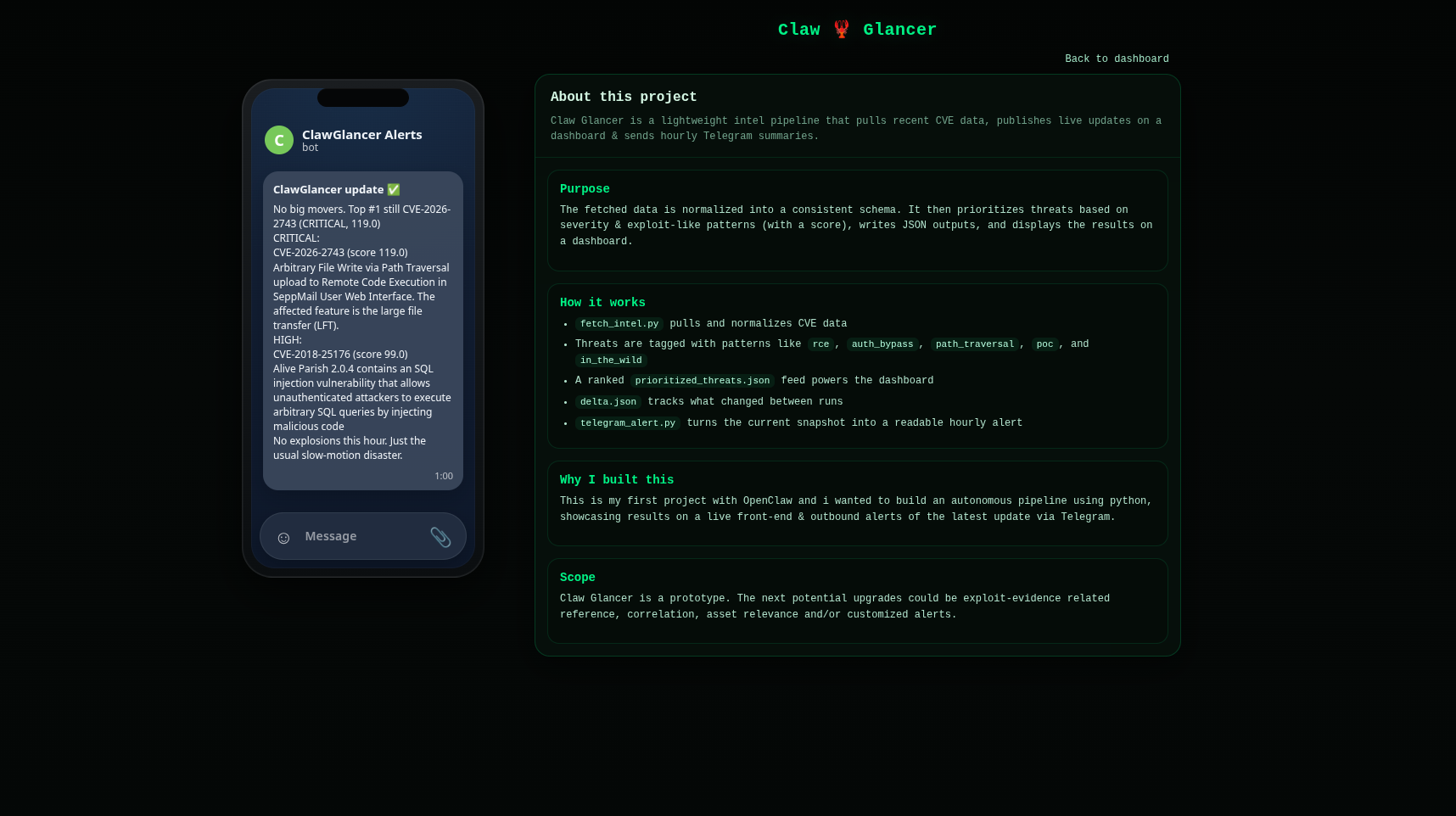
I ended up building Claw Glancer - a small CVE pipeline built for a straighforward task: pull recent vulnerability data, filter it, and rank what actually is highly impactful intel on a ranked dashboard (with a Telegram alert summary). This project enforced my understanding in terms of API key & token management even more when it comes to safety & predictability. Renting a VPS does not come with a laid back environment. The operational aspect is unavoidable and becomes a constant process of supervising network security & permissions.